- Apps
- Premium
-
Ubicaciones VPN
- Ayuda
- Registrarse
- Iniciar sesión
Are VPNs Legal? Mostly, but Not Everywhere
Contenido
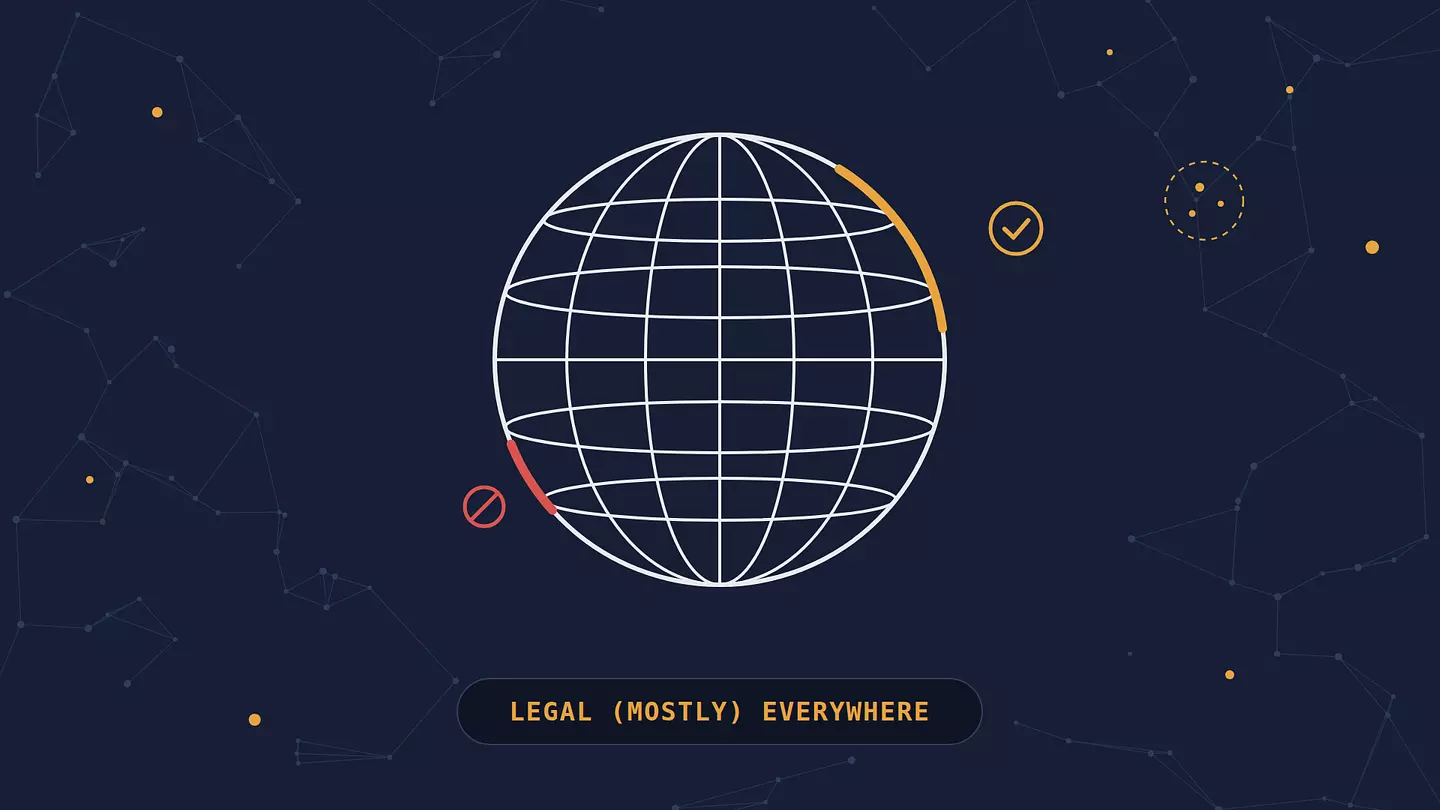
Using a VPN is legal in most countries, including the US, the UK, Canada, Australia, Japan, South Korea and every EU member state. You can use one to secure public Wi-Fi, keep your internet provider from logging your browsing, or reach content available in another region, and for personal use you don't need a license or registration. If you're new to the topic, start with how a VPN works.
That held even in 2026, when age-verification rules put VPNs under political pressure. The UK looked at age-restricting VPNs for under-16s and decided in July 2026 not to limit them. In the US, Utah passed a law making adult websites responsible for visitors located in the state even when they connect through a VPN, but a federal judge blocked that provision in September 2026. Neither move made it illegal for an adult to use a VPN.
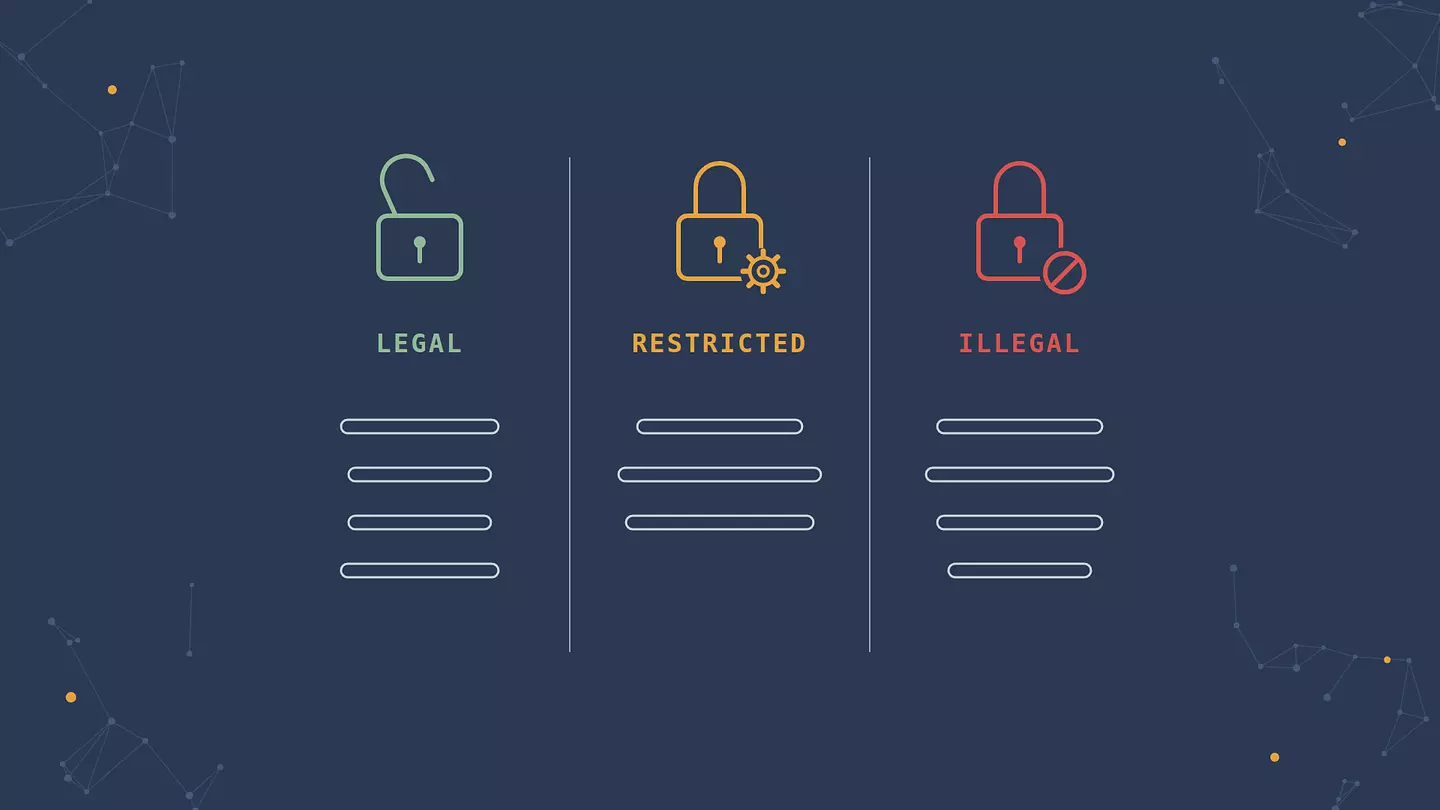
Outside that group, countries tend to fall into three patterns. Some keep VPN use legal but treat certain things you do through it, like reaching blocked content, as a separate offense. Some allow only VPNs that register with the government and follow its filtering rules. A few ban VPN use outright, or allow it only with special permission. The table below sorts countries by which pattern applies.
Where VPNs are restricted or banned
Laws in this area change, sometimes within weeks, so treat the table as a general picture and check current rules before you travel.
Country or region | Status | What that means |
|---|---|---|
United States, United Kingdom, Canada, EU, Australia, Japan, South Korea | Legal, no restrictions | Personal and business VPN use is unrestricted |
India | Legal, with caveats | Using a VPN isn't illegal. Since 2022, a CERT-In directive has required VPN providers serving the public to keep customer records for five years; VPNs that companies run for their own staff are exempt. See the section below |
United Arab Emirates | Legal, with caveats | Using a VPN for privacy or work is legal. Using one to commit a crime or reach content the authorities consider prohibited is a separate offense under the cybercrime law, with fines that can reach hundreds of thousands of dollars |
Egypt | Legal, with caveats | No law bans VPNs. Many sites are blocked, but the cybercrime law punishes having such tools only when they're used to commit or hide a crime (Masaar) |
Uganda | Legal, with caveats | VPNs were never outlawed. When people used them to avoid the 2018 social media tax, the regulator told ISPs to block VPN traffic, and VPN blocking returned around the 2021 election (OONI) |
Saudi Arabia | Legal, with caveats | No law addresses VPNs directly. Many sites are blocked, and using a VPN to commit an offense under the 2007 cybercrime law is punished like the offense itself |
Venezuela | Legal, with caveats | Using a VPN is legal, but in January 2025 the telecom regulator CONATEL had ISPs block the websites of more than 20 VPN providers, along with popular public DNS services (Tom's Guide) |
Iraq | Legal, with caveats | There's no VPN ban on the books. Authorities do block individual platforms (Telegram has been cut off more than once) and restricted VPNs temporarily in 2014 (Freedom House) |
China | Restricted | Only state-approved VPNs may operate, and they must follow the same filtering rules as other networks in the country. Since July 2024, state security officers can inspect phones and laptops without a warrant in situations they classify as emergencies (Taiwan News) |
Russia | Restricted | Since 2017, VPN services that don't connect to the state blocklist system can be blocked, and more than 450 had been by early 2026 (HRW). Advertising VPNs is finable, and since September 2025 so is deliberately searching for material on the official "extremist" list, including through a VPN. Using a VPN as such is not an offense (Interfax) |
Iran | Restricted | Since February 2024, using a VPN without a government permit is prohibited, and buying or selling VPNs was banned a year earlier. No penalty for users has been set (RFE/RL) |
Pakistan | Restricted | The telecom regulator PTA requires businesses and freelancers to register their VPNs, has licensed local VPN providers since 2025, and blocks unregistered VPN traffic (Dawn) |
Türkiye | Restricted | Using a VPN isn't illegal, but the telecom regulator orders ISPs to block VPN providers in batches, often around elections, protests or platform bans |
North Korea | Illegal | Ordinary citizens have no access to the global internet |
Belarus | Illegal | VPNs, Tor and other anonymizing tools have been banned since 2015 |
Turkmenistan | Illegal | VPN use is banned and blocked at the state level |
Oman | Illegal | Personal VPN use is prohibited; only organizations approved by the telecom regulator can use one legally |
Myanmar | Illegal | Under the Cybersecurity Law, in force since July 2025, setting up or providing a VPN without a license carries up to six months in prison and fines (Agenzia Nova) |
This isn't legal advice. Iraq shows why it's worth checking sources: it still appears on many "VPNs are banned" lists because of the 2014 restrictions, yet there's no ban in its laws, and in October 2025 the communications ministry reportedly denied any plans to introduce one. For regularly updated country reports, Freedom House's Freedom on the Net is a good reference.
Is a VPN legal in India?
Yes. No Indian law stops an individual from installing or using a VPN, whether for privacy, security on public Wi-Fi, or reaching content licensed for another region.
The rules that changed in 2022 apply to providers. In April that year, India's Computer Emergency Response Team, CERT-In, issued a directive requiring VPN providers, along with data centers and cloud providers, to record and store customer information for five years, even after a customer cancels. That includes names, validated addresses and IP address logs. The rule covers providers offering VPN service to the general public; internal corporate VPNs that companies run for their own employees are excluded. The original CERT-In directive is public if you want the source.
Several large providers stopped hosting servers in India in response. For users, nothing about the legality of using a VPN changed.
What happens if you use a VPN where it's restricted
The answer depends on the country and on what you were doing, more than on the VPN itself. In China, Russia and Iran, enforcement mostly happens at the network level: authorities block VPN services and remove apps from stores rather than pursue individual users. All three allow only VPNs that have government approval and follow local filtering rules. When cases do reach individuals, they have more often involved people selling or running unapproved VPN services than people simply using one.
Where VPNs are banned outright, the personal risk is higher. Myanmar's 2025 law punishes "setting up" a VPN without a license, and lawyers disagree on whether that covers someone who just installs an app. Even before the law took effect, soldiers were reported to be checking people's phones for VPN apps.
Before you travel
A few days before the trip, check the destination's current rules; an embassy or telecom regulator website is usually more up to date than articles. If you need a VPN for work, ask your employer how corporate VPNs are treated there, since the rules for them often differ. And a VPN doesn't change local laws on what content you're allowed to access.
A VPN doesn't make illegal things legal
A VPN hides your IP address and encrypts your traffic. The laws you're subject to stay the same. Fraud, breaking into other people's accounts or downloading pirated content are still offenses with a VPN on.
Terms of service are a separate matter. Watching a show that's only licensed in another region usually isn't against the law, but it often breaks the streaming service's terms, and that can get an account suspended. That's a contract issue with the platform, not a legal one.
FAQ
Is VPN use legal in India?
Yes, for individuals. There's no Indian law against installing or using a VPN. Since 2022, VPN providers serving the public must keep specific customer data for five years under a CERT-In directive (internal corporate VPNs are exempt). The rules cover how providers store data, not whether people may use a VPN.
Is it illegal to use a VPN?
In most countries, no. North Korea, Belarus, Turkmenistan, Oman and Myanmar ban VPN use outright or allow it only with official approval. China, Russia, Iran, Pakistan and Türkiye restrict which VPNs may operate or block providers regularly. A few more, such as the UAE and Saudi Arabia, keep VPN use legal but penalize certain things done through it.
Can you get in trouble for using a VPN?
Where VPNs are legal, normal use carries no legal risk. Where they're restricted or banned, the risk depends on local enforcement and on what you did through the VPN. Anything illegal on its own, like fraud, stays illegal wherever you are.
Do free VPNs change the legality of using a VPN?
No. Legality depends on your country and what you do, not on the price. What the choice of service affects is privacy, since some free VPNs make money from user data. Here's what to look for in a VPN provider, and you can check that your VPN connection works once it's set up.
Cita este artículo
Browsec. "Are VPNs Legal? Mostly, but Not Everywhere." Browsec Blog, 6 de noviembre de 2026, https://browsec.com/es/blog/are-vpns-legal.